Open Knowledge Architecture
EAI publishes position papers, standards discussion documents, and executive briefings as open-access resources for partners, researchers, and policy practitioners. All works are formally archived with persistent identifiers (Zenodo DOIs), each licensed under the Creative Commons licence stated on its own record and shown on its publication card.
Foundational Publications
Version 2.0 of the Hafez Framework. Establishes the regulatory gap through a comparative reading of the instruments that currently define agrivoltaics in law and technical standards in Germany, France, Italy and selected United States jurisdictions, and shows that these instruments share a design assumption that does not hold in most African contexts: that agricultural land is held under documented individual title, and that a single agricultural ministry can verify agronomic performance. Restructures the framework into seven governance pillars supported by two cross-cutting principles, and converts it into two usable instruments: an Agrivoltaics Qualification Gate and a five-level Governance Maturity Model. Section 4 publishes a full crosswalk from Version 1.0; no principle published in Version 1.0 has been withdrawn.
DOI: 10.5281/zenodo.21893885 →Proposes a conceptual model reframing why climate infrastructure projects in African economies stall between technical feasibility and financial close. Argues that the gap is a sequence gap rather than a preparation gap, and introduces the Institutional Readiness Threshold as a pre-feasibility condition comprising an institutional host, governance architecture, coordination protocols, disclosure infrastructure and a standardization pathway.
DOI: 10.5281/zenodo.21821400 →Introduces the Hafez Framework — a five-principle governance architecture (Auditable Governance, Blended Finance Readiness, Food-Energy-Water Integration, Institutional Compatibility, Embedded ESG) developed to address the structural intersection between food security, energy transition, and land-use efficiency through agrivoltaic systems in Africa.
DOI: 10.5281/zenodo.20111859 →Develops the Hafez Framework through a four-stage synthesis of agrivoltaics literature, comparative policy review, climate finance analysis, and governance gap analysis. Argues that agrivoltaic deployment in Egypt is constrained primarily by governance capacity, not by technology or capital availability.
DOI: 10.5281/zenodo.20762515 →Argues that the persistent gap between the technical feasibility of agrivoltaics and its ability to attract investment is best explained by the absence of standardized governance. Traces the chain connecting international benchmarks, national standards, monitoring and verification, auditable governance, and investment readiness.
DOI: 10.5281/zenodo.21412957 →Egyptian Agrivoltaics Standards Series · 4 of 5 Published
Examines the structural implications of the global agrivoltaic standardization gap for African deployment, with particular focus on Egypt. Drawing on the Italian precedent (CEI PAS 82-93) and the parallel German precedent (DIN SPEC 91434), proposes an exploratory pathway for initiating a national standardization process in Egypt.
DOI: 10.5281/zenodo.21377493 →Addresses a narrow, practical question: what should the governance component of an Egyptian agrivoltaic standard actually require. Proposes a minimum set of governance requirements grounded in ISO 37000 and in project-level practice already emerging in comparable sectors.
DOI: 10.5281/zenodo.21409478 →Addresses the technical parameters that distinguish genuine agrivoltaics from simple co-location of solar panels on agricultural land. Drawing on Germany's DIN SPEC 91434, proposes a minimum set of technical requirements adapted to the Egyptian context, including clearance height, area loss, yield retention, Land Equivalent Ratio reporting, and a water management requirement without direct precedent in the German model.
DOI: 10.5281/zenodo.21534672 →Translates the governance requirements of Paper 2 and the technical requirements of Paper 3 into evidence that is measurable, reportable and independently verifiable. Sets out eight MRV principles, six performance domains, a baseline architecture distinguishing pre-project conditions, a concurrent conventional reference and agrivoltaic performance, and eighteen core indicators in three tiers: qualification, performance, and evidence. Qualification rests on agricultural criteria alone. Quantitative thresholds are deliberately left to national calibration, and every reserved decision is listed. Annexes provide an extended catalogue of forty-six indicators, an indicator specification template, and the full specification of all eighteen core indicators against it.
DOI: 10.5281/zenodo.21935848 →Certification pathways, accreditation frameworks, and compliance mechanisms for Egyptian agrivoltaic systems.
Editorial & Strategic Series
Media Coverage & Recognition
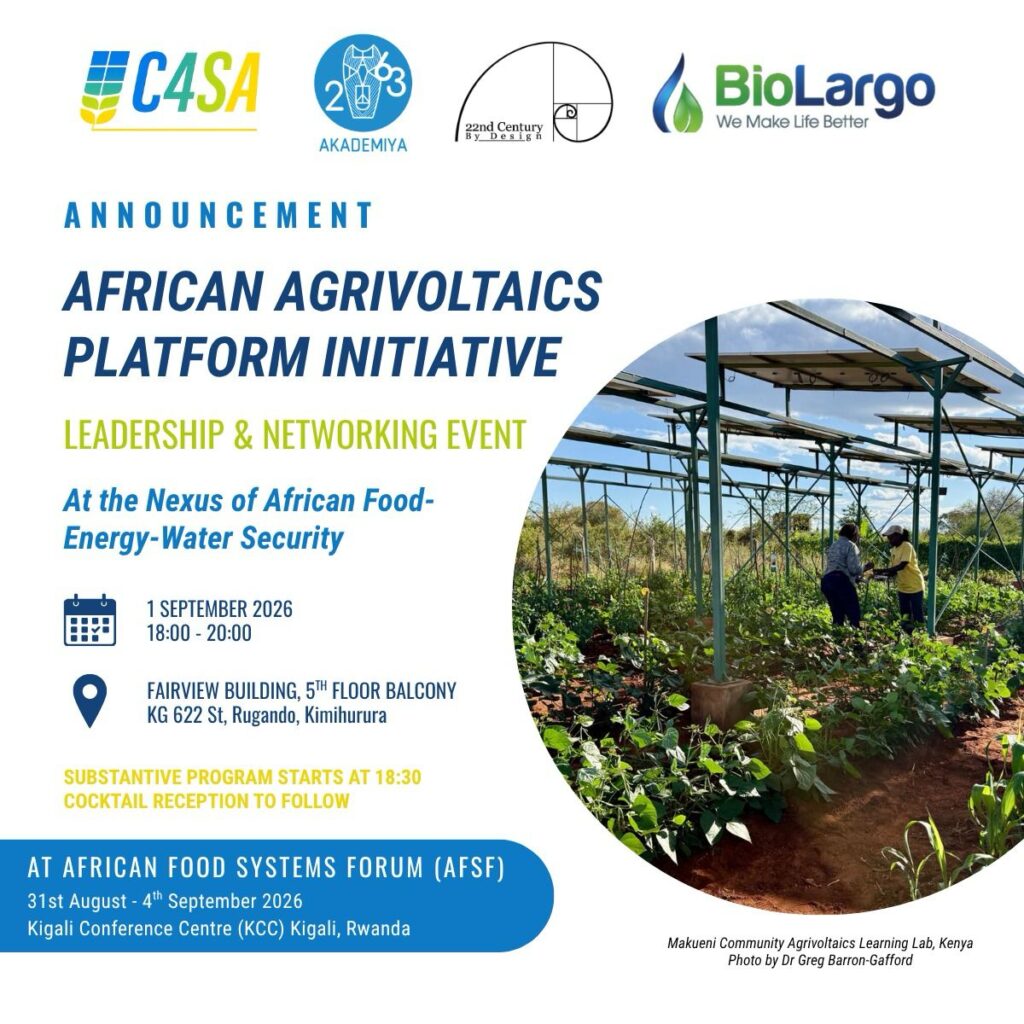 CONTINENTAL PLATFORM · FEATURE ARTICLE
C4SA's African Agrivoltaics Platform Sparks Partnerships in Egypt
Article produced with the Consortium for Sustainable Agrivoltaics (C4SA) and published on the Africa Food Systems Forum platform convened by AGRA. Subtitled “How a continental initiative launched in Paris is finding institutional resonance in Egypt”, it traces the path from the AAPI launch at OECD Paris to national action in Egypt across institutional dialogue, governance-ready frameworks and the standardization pathway.
Africa Food Systems Forum · AGRA · 19 August 2026
Read the article →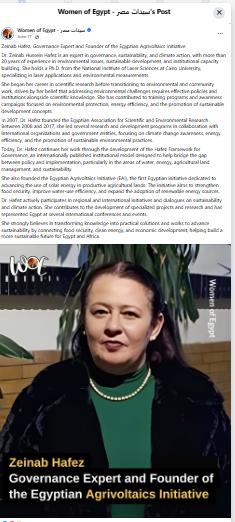 FEATURE ARTICLE
Zeinab Hafez, Governance Expert and Founder of the Egyptian Agrivoltaics Initiative
Feature article profiling the Founder's professional trajectory, the Hafez Framework, and the establishment of EAI as the first Egyptian initiative dedicated to advancing agrivoltaics on productive agricultural land.
Women of Egypt · June 2026
Read the feature →Egypt's First Commercial-Scale Agrivoltaics Pilot Will Deliver Results in September
Expert consultation provided as a governance specialist on Egypt's first commercial-scale agrivoltaics pilot, addressing institutional readiness, governance architecture and finance alignment as gating factors for sector development.
Enterprise AM · June 2026
Read the article →Cairo's Rooftop Farming Didn't Die, It Moved Upmarket
Analytical feature examining the transition of Cairo's rooftop farming sector toward hydroponics, controlled-environment agriculture and enterprise-market models. The Founder is quoted on the ecosystem constraints beyond the pilot stage and on the underlying investment economics of the sector.
Enterprise AM · July 2026
Read the article →