
An independent strategic platform advancing agrivoltaic governance and standardization in Egypt. Operating under the Hafez Framework architecture, and aligned with Egypt Vision 2030 and relevant national and continental frameworks, and contributing to Working Groups 1 and 2 of the African Agrivoltaics Platform Initiative.
First visit: the problem · what the framework establishes · the evidence · what EAI does · what can be commissioned
The Egyptian Agrivoltaics Initiative (EAI) is an independent strategic platform advancing the governance, standardization, and finance readiness of agrivoltaic systems in Egypt. Founded in April 2026, EAI works across three parallel tracks: intellectual foundations (open-access publications with permanent DOIs), institutional engagement (national and continental partnerships), and standardization pathways (Egyptian Agrivoltaics Standards Series).
EAI is an independent knowledge and standardization platform. It is not a project developer, an investment vehicle, a certification body or a regulatory authority.
To establish Egypt as a continental reference for governance-led agrivoltaic deployment, where energy transition, food security, and rural prosperity advance as a single integrated system.
To help build the institutional foundations for investment-ready agrivoltaic platforms, by combining institutional rigour, blended-finance readiness, and evidence-based alignment with national and continental frameworks.
Governance architecture precedes pilot deployment. EAI builds institutional and regulatory foundations intended to support informed capital deployment, so that scaling can occur within institutional arrangements established before major commitments are made.
An independent governance architecture for responsible agrivoltaics, addressing the structural intersection between food security, energy transition, land governance and climate resilience in Africa. The current version is 2.2, published on 26 September 2026. It rests on the structure introduced in Version 2.0: seven governance pillars supported by two cross-cutting principles, and two usable instruments, a Qualification Gate and a Governance Maturity Model. Version 2.2 makes the evidentiary layer explicit for three of those pillars: what a governance requirement must be capable of establishing, and when that question becomes material.
Every determination made under any pillar produces a traceable record identifying the decision, the evidence relied upon, the responsible party and the date. A pillar satisfied without an evidence trail is not satisfied.
The unit of assessment is the combined food, energy, water and land outcome of a defined area, not the electrical output of an installation. This principle determines what is measured under every other pillar.
Each pillar identifies the governance requirement it addresses and the basis on which that requirement can be evidenced, and is anchored to an existing international instrument rather than to assertion. Version 2.2 makes the evidentiary layer explicit for Pillars II, VI and VII, identifying the evidence questions that must be addressed when these requirements are assessed. The published framework defines the governance architecture and those questions; assessment instruments, scoring, weighting, thresholds, algorithms and operational decision rules are not part of this publication.
Agricultural production remains the primary land function. Energy generation is a co-product of an agricultural system, not an agricultural system tolerated on an energy site. Requires a documented pre-project baseline, crop-led design, and full removability at end of life.
ANCHORED TO
DIN SPEC 91434 and 91492; French Energy Code; Italian guidance; US state statutory definitions
Development begins with the legitimacy of the land relationship. All legitimate users must be identified, including customary, communal, seasonal, pastoral and female rights holders who may not appear in the statutory register. No investment readiness without land-use legitimacy.
ANCHORED TO
FAO Voluntary Guidelines on the Responsible Governance of Tenure; AU Framework and Guidelines on Land Policy in Africa; Guiding Principles on Large Scale Land Based Investments
Agrivoltaics crosses ministerial boundaries by construction. The question is not which body owns it, but how decision rights are allocated among those that share it, with verification separated from approval and a defined escalation forum.
ANCHORED TO
Country-platform practice; ISO 31000; COSO ERM
The parties carrying the land and climate risk participate in the value the project creates. Transparent arrangements across four beneficiary classes: farmers and land users, communities, public institutions and investors. The objective is distribution, not the avoidance of harm.
ANCHORED TO
Social provisions of the Voluntary Guidelines; ESG social reporting standards
Assessment at system level covering water-use efficiency, soil protection, microclimate, crop resilience, biodiversity, carbon implications, land degradation risk and lifecycle impacts including decommissioning.
ANCHORED TO
Italian guidance on light permeability and soil fertility; ISO 14001; financier safeguard standards
Governance is a precondition of finance, not an administrative activity performed after financing is secured. A ten-item Investment Readiness Gate covers land legitimacy, institutional mandate, technical feasibility, agricultural viability, safeguards, revenue logic, risk allocation, monitoring architecture, evidenced stakeholder commitments and named implementation responsibility.
ANCHORED TO
Blended finance country-platform architecture; climate finance absorption capacity analysis
The system is governed through verified evidence, and verified underperformance produces defined consequences. Measurement across agricultural, energy, and environmental, social and development performance, operating on a baseline, monitoring, independent verification, reporting, corrective action and adaptation cycle.
ANCHORED TO
DIN SPEC 91434 monitoring provisions; carbon market and climate finance MRV; ISO audit and corrective action logic
A project does not become agrivoltaics because photovoltaic modules are installed above agricultural land. The Gate separates responsible agrivoltaics from solar development sited on farmland, and it exists because the label carries consequences: preferential land-use treatment, differentiated tariff or auction access, agricultural subsidy eligibility and climate finance classification.
The five domains form the evidentiary gate, while the underlying seven-pillar assessment is applied in the sequence Land, Agriculture, Governance, Environment, Value, Finance and MRV, because land legitimacy is generally the earliest and most structurally consequential condition in the assessment.
A graded scale designed to support investment screening, differentiated policy incentives, national standard development and, potentially, future third-party certification. It is a framework-level classification and is not itself a certification.
PV infrastructure occupies agricultural land. No integrated agricultural governance model. Farming, where it continues, is incidental and unmeasured.
Agriculture continues alongside the installation. Governance integration is limited and agricultural performance is not systematically measured.
Agricultural and energy systems are jointly designed and jointly monitored. A baseline exists. Institutional responsibility is identifiable.
The project satisfies the Qualification Gate across all five domains. This is the level at which the framework's classification applies. It is a framework-level classification and not a certification.
Verified improvement, not merely maintenance, across agricultural resilience, resource efficiency, distributed community value and climate outcomes, sustained across more than one full production cycle.
Four capabilities, built on the framework and applied to the question that comes before any project can be permitted, financed or replicated: do the agricultural and energy orders actually meet on the same land, and on what conditions?
Building auditable evidence structures for agrivoltaic governance and investment decisions: what must be established, by whom, against which reference, and with what record.
Mapping land, regulatory, institutional and governance conditions before project commitment, and identifying which of them are unresolved.
Translating governance and technical requirements into measurable, reportable and independently verifiable systems.
Connecting institutional readiness to the requirements of blended finance and institutional investment, without substituting for project-level due diligence.
If you are weighing a site, a programme or an investment, the question that comes first is whether its land, institutional, governance and evidence foundations hold. That reading can be commissioned, and the four assignments below are the forms it usually takes.
EAI is an open knowledge and standardization platform, and its published work is free to use under the licence stated on each record. Commissioned assessments and professional advisory assignments are undertaken separately by the Founder in her professional capacity, are contracted in writing, and do not constitute an EAI endorsement, designation or certification of any project, developer or jurisdiction. These assignments are not performed by EAI and do not create an EAI project designation or institutional endorsement.
An independent reading of whether a proposed project or national programme has the land, institutional, governance and evidence foundations required before investment or designation.
Which instruments apply, which authority holds which decision, and where the agricultural and energy orders meet or fail to meet.
What a project must evidence, to whom, against which reference basis, and how that evidence is verified and held.
Turning a verified institutional record into a form usable in implementation and financing decisions.
Commission an assessment Write to info@egyptianagrivoltaicsinitiative.org with the site, programme or decision in view, and the timeline. A scope and fee note follows.
The line between the two is the difference between method and application. A working group may develop general principles for institutional mapping; assessing the instruments that govern a particular site, project, ministry or investment is commissioned work. Where independent verification of performance is required, it remains with a party that holds no interest in the outcome. EAI does not verify the projects it assesses and does not assess projects in which it holds an interest.
The Initiative's Design Phase is supported by four expert working groups. Each group contributes to an open knowledge output within its defined scope. Together, the outputs establish part of the Initiative's knowledge and methodological foundation; they do not constitute commissioned client work. Founding contributors are currently being onboarded, and the call remains open.
Onboarding contributors
Literature, comparable operating cases, and agronomic and energy benchmarks for Egyptian and comparable arid conditions, with the quality and transferability of the evidence stated.
Regulatory interfaces, institutional responsibilities, partnership architecture and host alignment, applying the pillars of the Hafez Framework.
Site characterisation, system configuration, crop and photovoltaic compatibility, technical parameters, performance indicators and monitoring requirements.
Research and institutional counterparts, donor and academic engagement, continental and multilateral linkages, and partnership readiness.
Three further groups are planned for a later stage: climate and blended finance; measurement, reporting and verification; and communications. Expressions of interest are reviewed within fourteen days.
Expressions of interest: info@egyptianagrivoltaicsinitiative.org · subject line: EAI Founding Contributors, followed by the working group.
Three levels are distinguished below, and they are not the same thing: what EAI has documented participation in, what the framework contributes as a method, and where its work is relevant to a policy framework without EAI forming part of it.
EAI contributes governance, evidence and climate-finance readiness perspectives through participation in Working Group 1, Evidence and Capacity Building, and Working Group 2, Climate and Blended Finance.
Structured review contributions to the draft, and contributor status in the advance edition of September 2026, where EAI's published work is cited in four places. Details.
A proposed national agrivoltaics standardization pathway submitted for consideration, with the Egyptian Agrivoltaics Standards Series published openly in support of it.
The Hafez Framework offers a method for assessing whether the agricultural and energy orders meet on the same land, and what a project must evidence before it can be permitted, financed or replicated.
The Standards Series translates governance and technical requirements into indicators, a baseline architecture and verification requirements, with quantitative thresholds reserved to national calibration.
EAI's governance and standardization work addresses the intersection of agricultural productivity, renewable energy and sustainable development within Egypt's national policy context.
Dual land use that keeps productive farmland in production is relevant to regional objectives on land restoration and climate-resilient agriculture.
The work is relevant to the food, energy and water nexus that the national programme addresses. EAI is not a participant in that programme.
The subject matter is relevant to Goals 2, 7, 13, 15 and 17. EAI is a knowledge platform and not an implementing body.
The framework is designed to be compatible with the readiness requirements of climate finance facilities and blended finance vehicles, without implying any institutional relationship with them.
EAI follows a deliberate sequence: institutional foundations first, capital alignment second, deployment third. This sequence ensures that scaling occurs within proven institutional frameworks.
Development and open publication of the Hafez Framework, now at Version 2.2. Continental engagement through the working groups of the African Agrivoltaics Platform Initiative. National institutional engagement under way. A joint research collaboration with a European research partner is under way. Open-access records archived on Zenodo with permanent DOIs.
Active · 2026Egyptian Agrivoltaics Standards Series (five-paper series) proposing an exploratory pathway toward a national agrivoltaic specification, submitted for consideration by the Egyptian Organization for Standardization and Quality.
Active · Q3 2026 – Q1 2027Blended-finance vehicle design, concessional capital alignment, and institutional investor engagement. Translation of governance principles into financing instruments.
Q4 2026 – Q2 2027Site identification, feasibility assessment, stakeholder coordination, and operational framework development. First demonstration sites within transparent governance.
2027Operational deployment at scale across Egypt, with continental knowledge transfer, institutional capacity building, and potential replication through interested African countries and partner institutions.
2028+A structured registry of Egyptian projects in which solar generation and agricultural activity occur on the same land, recording what each project is, where it is, who is involved, and what is established about it and on what published source.
The registry deliberately separates what a project is described as from what has been independently documented about it. That gap is the subject of the Initiative's work rather than a judgement on any project. The registry is under development, and the figures above will change as records are added and as permissions are obtained from the parties concerned. As the comparative study is completed, its evidence tables will be deposited with a persistent identifier and referenced from the public record.
EAI publishes position papers, standards discussion documents, and executive briefings as open-access resources for partners, researchers, and policy practitioners. All works are formally archived with persistent identifiers (Zenodo DOIs), each licensed under the Creative Commons licence stated on its own record and shown on its publication card.
Where two uses are proposed for the same parcel of land, each is governed by its own regulatory order, and the two orders were written without reference to one another. Whether the combination is institutionally supported is therefore answered by neither. This paper sets out what has to be asked: seven questions restating the pillars of the Hafez Framework as questions about coexistence, three rules for interpreting them, and six propositions offered as hypotheses for testing against primary instruments. It states what must be established and leaves how an answer is graded outside its scope. The questions are not specific to agriculture and energy; they apply wherever two uses compete for the same ground.
DOI: 10.5281/zenodo.22982019 →The Hafez Framework, current version. Establishes the regulatory gap through a comparative reading of the instruments that currently define agrivoltaics in law and technical standards in Germany, France, Italy and selected United States jurisdictions, and identifies assumptions embedded in these instruments that may not hold across many African contexts: that agricultural land is held under documented individual title, and that a single agricultural ministry can verify agronomic performance. Restructures the framework into seven governance pillars supported by two cross-cutting principles, and converts it into two usable instruments: an Agrivoltaics Qualification Gate and a five-level Governance Maturity Model. Section 4 publishes a full crosswalk from Version 1.0; no principle published in Version 1.0 has been withdrawn. Version 2.2 makes the evidentiary layer explicit for Pillars II, VI and VII, states the scope limit of the framework, and maps each governance function to the question its evidence must answer. It publishes no full assessment instrument, scoring or weighting system, evidence-sufficiency algorithm, aggregation method, threshold set or operational decision rule.
DOI (v2.2): 10.5281/zenodo.22980834 →Proposes a conceptual model reframing why climate infrastructure projects in African economies stall between technical feasibility and financial close. Argues that the gap is a sequence gap rather than a preparation gap, and introduces the Institutional Readiness Threshold as a pre-feasibility condition comprising an institutional host, governance architecture, coordination protocols, disclosure infrastructure and a standardization pathway.
DOI: 10.5281/zenodo.21821400 →Introduces the Hafez Framework — a five-principle governance architecture (Auditable Governance, Blended Finance Readiness, Food-Energy-Water Integration, Institutional Compatibility, Embedded ESG) developed to address the structural intersection between food security, energy transition, and land-use efficiency through agrivoltaic systems in Africa.
DOI: 10.5281/zenodo.20111859 →Develops the Hafez Framework through a four-stage synthesis of agrivoltaics literature, comparative policy review, climate finance analysis, and governance gap analysis. Argues that agrivoltaic deployment in Egypt is constrained primarily by governance capacity, not by technology or capital availability.
DOI: 10.5281/zenodo.20762515 →Argues that the persistent gap between the technical feasibility of agrivoltaics and its ability to attract investment is best explained by the absence of standardized governance. Traces the chain connecting international benchmarks, national standards, monitoring and verification, auditable governance, and investment readiness.
DOI: 10.5281/zenodo.21412957 →Examines the structural implications of the global agrivoltaic standardization gap for African deployment, with particular focus on Egypt. Drawing on the Italian precedent (CEI PAS 82-93) and the parallel German precedent (DIN SPEC 91434), proposes an exploratory pathway for initiating a national standardization process in Egypt.
DOI: 10.5281/zenodo.21377493 →Addresses a narrow, practical question: what should the governance component of an Egyptian agrivoltaic standard actually require. Proposes a minimum set of governance requirements grounded in ISO 37000 and in project-level practice already emerging in comparable sectors.
DOI: 10.5281/zenodo.21409478 →Addresses the technical parameters that distinguish genuine agrivoltaics from simple co-location of solar panels on agricultural land. Drawing on Germany's DIN SPEC 91434, proposes a minimum set of technical requirements adapted to the Egyptian context, including clearance height, area loss, yield retention, Land Equivalent Ratio reporting, and a water management requirement without direct precedent in the German model.
DOI: 10.5281/zenodo.21534672 →Translates the governance requirements of Paper 2 and the technical requirements of Paper 3 into evidence that is measurable, reportable and independently verifiable. Sets out eight MRV principles, six performance domains, a baseline architecture distinguishing pre-project conditions, a concurrent conventional reference and agrivoltaic performance, and eighteen core indicators in three tiers: qualification, performance, and evidence. Qualification rests on agricultural criteria alone. Quantitative thresholds are deliberately left to national calibration, and every reserved decision is listed. Annexes provide an extended catalogue of forty-six indicators, an indicator specification template, and the specification of all eighteen core indicators against it. Indicator definitions are not an assessment engine: they do not disclose the non-public logic used to weigh, aggregate or classify evidence.
DOI: 10.5281/zenodo.21935848 →Certification pathways, accreditation frameworks, and compliance mechanisms for Egyptian agrivoltaic systems.
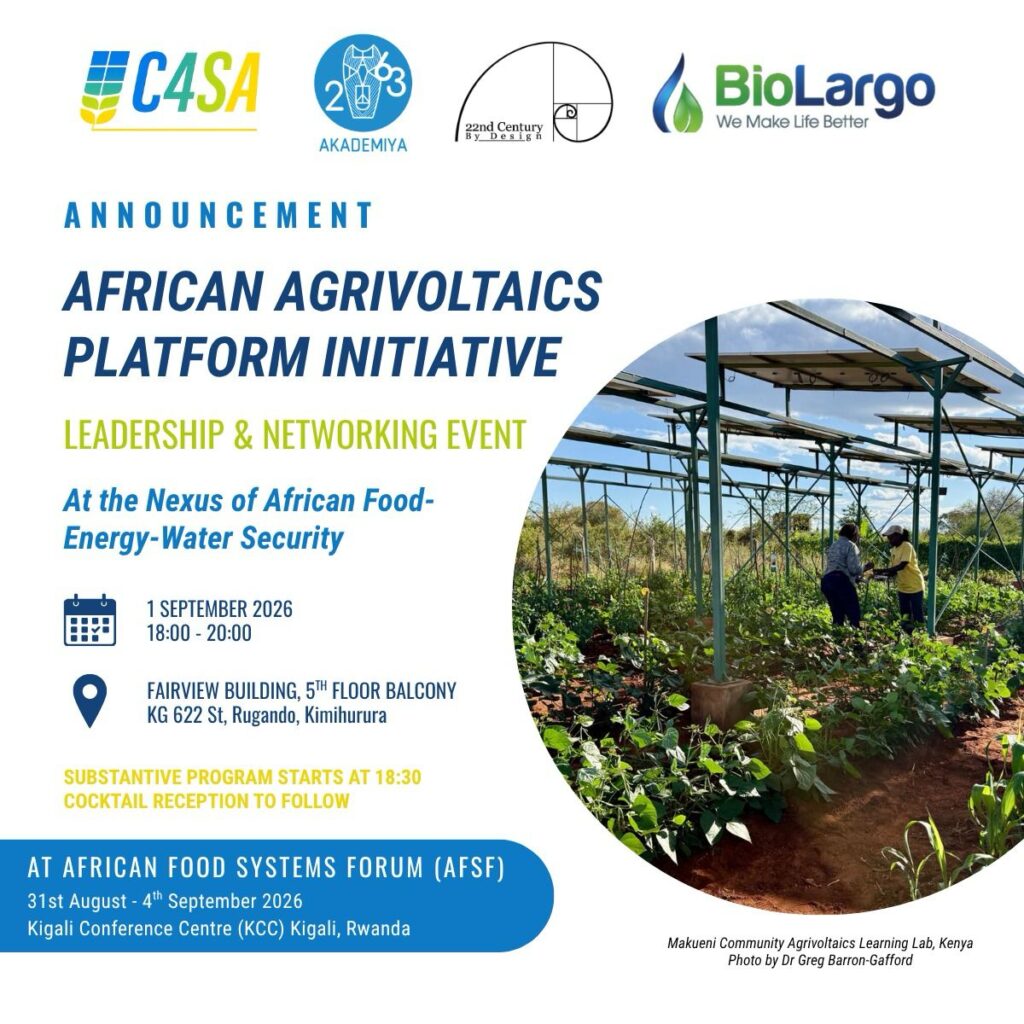 CONTINENTAL PLATFORM · FEATURE ARTICLE
Article produced with the Consortium for Sustainable Agrivoltaics (C4SA) and published on the Africa Food Systems Forum platform convened by AGRA. Subtitled “How a continental initiative launched in Paris is finding institutional resonance in Egypt”, it traces the path from the AAPI launch at OECD Paris to national action in Egypt across institutional dialogue, governance-ready frameworks and the standardization pathway.
Africa Food Systems Forum · AGRA · 19 August 2026 · Republished with author byline, 27 August 2026
Read the article →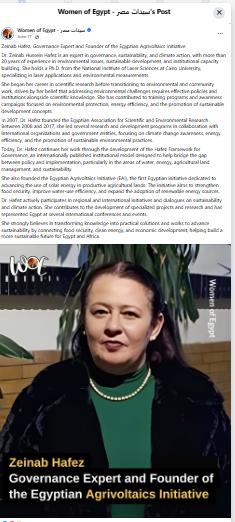 FEATURE ARTICLE
Feature article profiling the Founder's professional trajectory, the Hafez Framework, and the establishment of EAI as an Egypt-based initiative dedicated to advancing agrivoltaics on productive agricultural land.
Women of Egypt · June 2026
Read the feature →Expert consultation provided as a governance specialist on Egypt's first commercial-scale agrivoltaics pilot, addressing institutional readiness, governance architecture and finance alignment as gating factors for sector development.
Enterprise AM · June 2026
Read the article →Analytical feature examining the transition of Cairo's rooftop farming sector toward hydroponics, controlled-environment agriculture and enterprise-market models. The Founder is quoted on the ecosystem constraints beyond the pilot stage and on the underlying investment economics of the sector.
Enterprise AM · July 2026
Read the article →The Egyptian Agrivoltaics Initiative records its sincere appreciation to Mr. Christopher Hegadorn, Founder and President of the Consortium for Sustainable Agrivoltaics (C4SA), and to the National Laboratory of the Rockies (formerly NREL), and in particular to the distinguished scientist Jordan Macknick, for the invitation to take part in the two working groups of the African Agrivoltaics Platform Initiative and for the opportunity to contribute to the African Agrivoltaics Handbook (AAPI Working Group 1, advance edition, September 2026). EAI's contribution is described on the Handbook contribution page.
EAI is grateful for the collegial spirit of this continental work and for the opportunity to contribute to it alongside colleagues from across Africa and beyond.
Recent institutional engagements, publications and developments. The ten most recent are shown.
Version 2.2 of the Hafez Framework archived on Zenodo (DOI 10.5281/zenodo.22980834), making the evidentiary layer explicit for Pillars II, VI and VII and stating the scope limit of the framework. Published alongside it, the working paper "What Must Be Asked Before Land Use Is Called Dual" (DOI 10.5281/zenodo.22982019) restates the seven pillars as questions about the coexistence of two uses on the same land.
A joint research collaboration with a European research partner is under way.
The advance edition of the African Agrivoltaics Handbook was released by the Consortium for Sustainable Agrivoltaics (C4SA) in Kigali. Dr. Hafez is listed among its contributors. EAI's work is cited in Section 5.1 (finance gap), Table 3 (regulatory barrier) and Section 8.2, where Egypt is presented as a proposed national coordination example hosting the Hafez Governance Framework, and is reflected in the Conclusion. Access the Handbook → · EAI's contribution →
The Africa Food Systems Forum, hosted by AGRA, republished the human-interest story by Dr. Zeinab Hussein Hafez, prepared at the request of C4SA and first published on 19 August 2026, now carrying her byline ahead of the Kigali reception. The article traces the Initiative's origins, explains why scaling agrivoltaics in Egypt is an institutional readiness challenge rather than a purely technical one, and describes the standardization proposal submitted to the Egyptian Organization for Standardization and Quality. Read the article →
"Measurement, Reporting and Verification Requirements for a National Agrivoltaics Standard: Turning Requirements into Evidence" archived on Zenodo (DOI 10.5281/zenodo.21935848). The paper proposes eighteen core indicators in three tiers, a baseline and reference architecture, and independent verification requirements, with quantitative thresholds reserved to national calibration. Four of the five papers in the Egyptian Agrivoltaics Standards Series are now published.
Version 2.0 of the Hafez Framework archived on Zenodo (DOI 10.5281/zenodo.21893885). The framework is restructured into seven governance pillars supported by two cross-cutting principles, each pillar anchored to an existing international instrument, and converted into two usable instruments: an Agrivoltaics Qualification Gate and a five-level Governance Maturity Model. A full crosswalk from Version 1.0 is published in Section 4; no principle from the earlier version has been withdrawn.
"The Institutional Readiness Threshold: Reordering the Climate Infrastructure Investment Sequence" archived on Zenodo (DOI 10.5281/zenodo.21821400), proposing a conceptual model that treats institutional readiness as a pre-feasibility condition rather than a downstream compliance step.
"Proposed Technical Requirements for Egyptian Agrivoltaics Standardization" archived on Zenodo (DOI 10.5281/zenodo.21534672), drawing on Germany's DIN SPEC 91434 to propose technical requirements adapted to the Egyptian context, with particular attention to water management.
The Founder was consulted by Enterprise AM as a governance specialist for two features on Egypt's land-use and energy transition: coverage of Egypt's first commercial-scale agrivoltaics pilot, and an analysis of the transition of Cairo's rooftop farming sector.
"Governance Requirements for Egyptian Agrivoltaics Standardization" (Standards Series Paper 2) and "From Governance to Bankability" (policy paper) archived on Zenodo, expanding the EAI open-knowledge portfolio to five publications.
Paper 1 of the five-part Egyptian Agrivoltaics Standards Series ("Why Egypt Needs a National Agrivoltaics Standard: Learning from the Italian Precedent") archived on Zenodo, marking the launch of the standardization pathway.
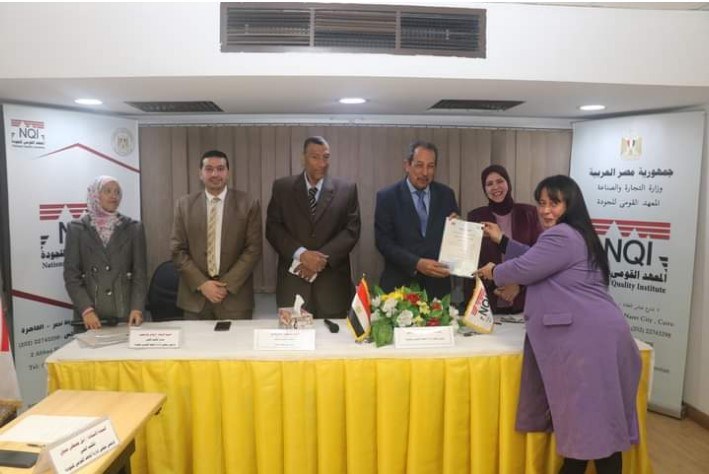
Governance, sustainability and climate practitioner with more than 25 years of professional experience across environmental management, institutional governance and donor-funded programme delivery in Egypt. Her work spans the management of a UNDP and GEF energy efficiency and climate change mitigation programme, nine years of environmental impact assessment for industrial facilities, the direction of a research centre, and institutional governance and ESG evaluation in the agricultural research sector. She is a Certified Quality Manager (National Quality Institute) and a certified auditor for ISO 9001, ISO 14001 and ISO 45001 management systems, with auditing and risk management training under ISO 19011 and ISO 31000. PhD from the National Institute of Laser Sciences at Cairo University.
Architect of the Hafez Framework and Founder of the Egyptian Agrivoltaics Initiative — an Egyptian initiative dedicated to advancing solar energy on productive agricultural land to strengthen food security, water-use efficiency, and renewable energy adoption.
Work led by the founder through the Egyptian Association for Scientific and Environmental Research between 2007 and 2017, on energy efficiency, awareness and environmental practice, before the Initiative was established, together with a professional credential received in 2022.


EAI welcomes strategic engagement from institutional partners across the agrivoltaic ecosystem. Each partnership pathway operates within the governance principles of the Hafez Framework.
Policy coordination, institutional integration, and national strategic alignment.
Concessional capital, blended-finance vehicles, and project preparation facilities.
Impact-aligned investment opportunities within transparent governance frameworks.
Joint research, knowledge production, and technical methodology development.
Capacity building, curriculum development, and student engagement programmes.
Coordination on national standardization pathways, certification frameworks, and accreditation systems.
Climate fund alignment, MRV systems, and carbon market integration.
Facility management, asset operations, and lifecycle stewardship expertise.
The Initiative builds evidence and the institutional record. It does not promote projects, endorse developers or certify performance. Where independent verification is required, it remains with a party that holds no interest in the outcome.
For strategic dialogue, partnership inquiries, or institutional engagement, please connect through the channels below. EAI welcomes substantive conversations with aligned institutions and qualified partners.
Dr. Zeinab Hussein Hafez
Founder, Egyptian Agrivoltaics Initiative
Email: info@egyptianagrivoltaicsinitiative.org
LinkedIn: linkedin.com/in/zeinab-hafez-phd
ORCID: 0000-0001-5183-2876
Newsletter: The Agrivoltaics Brief